Merrowyn
Contents
Overview
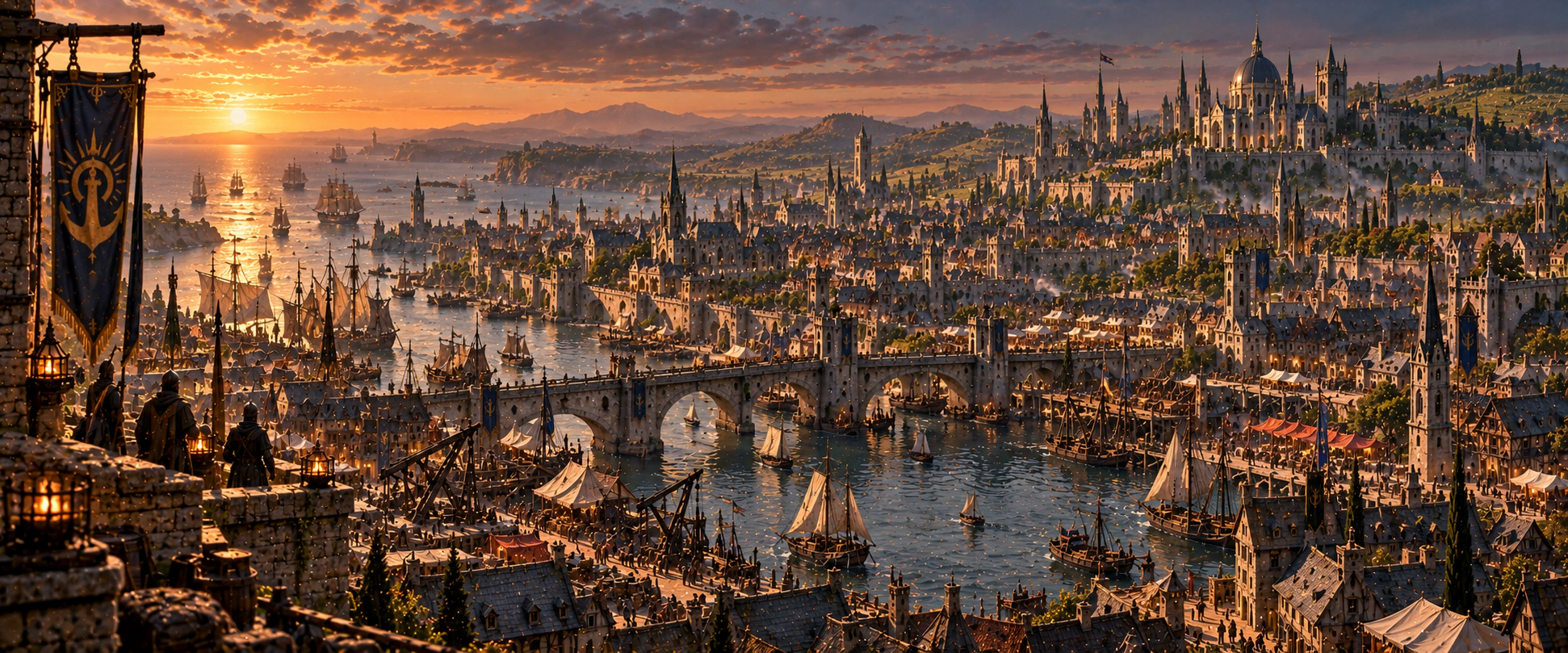
Merrowyn is the capital of the mercantile republic of the same name and the foremost commercial and financial centre of the Crownlands. Home to approximately 100,000 people, the city occupies the mouth of the Wexford River, where trade from the Crownlander interior meets the maritime routes of the Tyrethian Sea.
Renowned for its bustling harbours, extensive markets, powerful guilds and banking houses, Merrowyn is among the wealthiest cities in Manullyn. Its prosperity has attracted merchants, sailors, artisans and travellers from across the continent, establishing a diverse and cosmopolitan population.
Unlike the hereditary fiefdoms of the Crownlands, Merrowyn is governed by a mercantile republic under the Grand Council, presided over by First Speaker Lucien Varrick. Although noble houses retain considerable wealth and social standing, political authority rests primarily with the city’s commercial institutions.
Merrowyn is a city of extraordinary opportunity, where ambition and enterprise are celebrated, provided one possesses the means to pursue them.
Geography
Merrowyn occupies a broad river valley opening westwards onto the Tyrethian Sea. The Wexford River flows through the heart of the city, dividing its northern and southern districts before widening into a substantial estuary.
The northern valley slopes are occupied by wealthy residential neighbourhoods and civic institutions, while the southern bank is dominated by markets, workshops and densely populated commercial quarters. Extensive docks, shipyards and warehouses line both banks of the lower Wexford, extending towards the river mouth.
Several bridges connect the city’s districts, the largest and oldest being the Grand Wexford Bridge. Roads lead eastwards towards the agricultural settlements of Riverwell and the wider Crownlands, while the surrounding valley slopes provide commanding positions for the city’s fortifications.
Beyond the urban walls, farmland and smaller settlements support the city’s considerable population.
Government
Merrowyn is governed by the Grand Council, comprising the heads of its eight Great Guilds, the Commander of the Guard and the First Speaker.
The Great Guilds represent the principal sectors of the republic’s economy. Each guildmaster is elected by a majority of eligible guild members, with their appointment requiring the assent of the First Speaker. The Commander of the Guard is appointed directly by the First Speaker.
The First Speaker is elected by the Grand Council for a seven-year term, with reelection permitted. The office presides over council proceedings, confirms guild appointments and holds final authority in council arbitrations and major disputes, operating within the established laws of the republic.
The current First Speaker, Lucien Varrick, is a half-elf merchant-statesman in his late fifties whose career was built upon shipping and commercial finance. Calculating, personable and exceptionally well informed, Varrick is regarded as an effective administrator who has successfully maintained Merrowyn’s longstanding economic supremacy.
The Eight Great Guilds
The guilds are broad institutions encompassing numerous trades, professions and smaller associations. They establish professional standards, administer apprenticeships, regulate commercial activity and represent their members within government.
Guild of Merchants: Domestic and international trade, merchant houses, wholesale markets and commercial contracts.
Guild of Mariners: Commercial shipping, navigation, maritime training and seafaring professions.
Guild of Shipwrights: Shipbuilding, repairs, sail-making, rope-making and maritime manufacture.
Guild of Coin: Banking, lending, investment, insurance and currency exchange.
Guild of Factors: Warehousing, freight distribution, cargo handling, customs and logistics.
Guild of Artisans: Skilled manufacture, workshops, textiles, metalworking and professional crafts.
Guild of Landholders: Agriculture, rural estates, property and the supply of raw materials.
Guild of Civic Works: Construction, bridges, roads, canals, waterworks and public infrastructure.
Although equal in constitutional standing, the guilds vary considerably in membership, wealth and political influence. Their competing interests make negotiation and coalition-building essential to the republic’s governance.
Culture
Merrowyn is an energetic, cosmopolitan city whose streets and harbours rarely fall quiet. Merchant vessels arrive with the tides, markets operate from early morning until late evening, and its taverns, inns and trading halls are filled with people conducting business or seeking opportunity.
The city’s population is exceptionally diverse, with people of numerous species and cultures living and working alongside one another. Commercial reputation, professional standing and wealth generally carry greater importance than ancestry, although established noble families continue to occupy much of the city’s upper social class.
Merrowyn celebrates ambition and enterprise, and its institutions provide opportunities for individuals to rise through trade, craftsmanship and professional achievement. Nevertheless, substantial class divisions persist. Wealthy merchants and nobles inhabit grand residences overlooking the city, while labourers, dockworkers and poorer families occupy crowded neighbourhoods closer to the waterfront.
Contracts, commercial honesty and professional reputation are held in particularly high regard. Ruthless negotiation is widely accepted, but fraud, counterfeiting and deliberate breaches of trust are treated seriously.
The city is comparatively tolerant of Arcane magic, regarding lawful magical services as another valuable profession. This attitude has occasionally brought its institutions into conflict with the increasingly influential Order of the Last Dawn.
Trade and Economy
Merrowyn is the principal financial and commercial power of the Crownlands. Its position at the mouth of the Wexford allows goods from the interior to be transported directly to the Tyrethian Sea, while imported cargo passes through its harbours before being distributed throughout the region.
The city’s economy is supported by maritime commerce, shipbuilding, skilled manufacture, warehousing, banking and investment. Its guilds regulate vast commercial networks, while its financial institutions provide loans and credit to merchants, landowners and governments across the Crownlands.
Merrowyn’s influence extends far beyond its borders. Neighbouring fiefdoms depend upon its ports, commercial networks and financial services, giving the republic considerable diplomatic leverage despite its comparatively modest territorial and military strength.
Military
Merrowyn maintains a professional city guard responsible for public order, the protection of commercial interests and the defence of the republic. Its forces are disciplined and well equipped, though considerably smaller than those of the more militarised Crownlander fiefdoms.
The Commander of the Guard, appointed by the First Speaker, oversees the city’s defensive forces from Southwatch Keep. Guard towers positioned along the walls, principal bridges and harbour approaches provide observation and communication, using bells, flags and signal lanterns.
The republic also maintains capable naval forces to escort merchant vessels, patrol coastal waters and combat piracy. Although effective against ordinary maritime threats, its forces have occasionally required assistance from neighbouring states when confronted by substantial pirate incursions.
Merrowyn is also willing to employ mercenary companies when additional military strength is required, preferring to supplement its permanent forces rather than maintain an unnecessarily large standing army.
History
Merrowyn originated as a collection of small fishing villages along the mouth of the Wexford River. The arrival of Aldrich Lester’s Grand Unification Crusade brought considerable investment and infrastructure to the region, allowing the settlements to expand rapidly. Their strategic position, linking the interior of the emerging Lesterian Empire with the Tyrethian Sea, soon established Merrowyn as one of its most important centres of trade.
Following the Long Dissolution, the noble houses that emerged throughout the Crownlands struggled to establish the same political authority in Merrowyn. The city’s considerable wealth meant that commercial influence increasingly outweighed hereditary standing, and its growing merchant guilds gradually assumed responsibility for civic administration. Their cooperative system of governance eventually developed into the Grand Council of Merrowyn, establishing the mercantile republic that survives today.
Throughout the succession disputes and territorial conflicts that followed the Empire’s collapse, Merrowyn maintained a largely neutral position, preserving its commercial relationships with the neighbouring fiefdoms. Its financial importance has generally discouraged direct challenges to its independence, while its banking houses and merchants have continued to support trade throughout the Crownlands.
Merrowyn’s prosperity has nevertheless attracted threats from beyond its borders, particularly pirates operating across the Tyrethian Sea. Although the republic maintains capable professional forces and maritime defences, its comparatively modest military has occasionally struggled against larger incursions. On several occasions, neighbouring states have provided military assistance, reflecting the mutual dependence between Merrowyn’s economic strength and the security of the wider Crownlands.
Districts
Highseat Gardens
The political and financial heart of Merrowyn, occupying the northern valley slopes overlooking the city. Highseat Gardens is distinguished by its grand residences, banking houses, formal gardens and imposing civic buildings. Concord Hall and the headquarters of the Guild of Coin are situated here, alongside the administrative offices of the Guild of Civic Works.
Gilded Harbours
The sprawling maritime district extending along both banks of the lower Wexford and around its mouth. Its name derives from the local saying that so much coin passes through Merrowyn that even its streets have turned to gold. The Guilds of Mariners and Shipwrights maintain their headquarters amongst its docks, jetties, shipyards and chandlers.
The Books
An extensive district of warehouses, bonded storage yards, counting offices and freight depots. Much of the cargo entering or leaving Merrowyn is recorded, inspected or stored here, under the oversight of the Guild of Factors. The district takes its name from the countless ledgers documenting the movement of goods through the city.
Riverwell
Originally an independent farming settlement along the Wexford, Riverwell was gradually absorbed by Merrowyn’s expansion. Now the largest district by area, it encompasses older village streets, mills, newer residential neighbourhoods and extensive agricultural land beyond the walls. The Guild of Landholders maintains its headquarters here.
Auromtown
The principal market district of Merrowyn, occupying much of the southern bank of the Wexford. Its crowded streets are filled with shops, workshops, trading halls, inns and market stalls offering goods from across Manullyn. The Guilds of Merchants and Artisans operate here. In recent years, rumours of increasingly organised black-market activity have begun to circulate amongst its traders.
Waterstead
A densely populated working-class district situated towards the Tyrethian coast. Waterstead is home to dockworkers, labourers, sailors’ families and many of the city’s less affluent residents. Its crowded streets contain modest housing, inexpensive inns and lively neighbourhood taverns. The Guild of Civic Works maintains its principal workshops and operational depots here.
Points of Interest
Concord Hall
Situated amongst the terraced gardens of Highseat, Concord Hall is the seat of the Grand Council and the political centre of the republic. The imposing pale-stone building contains the council chamber, administrative offices, arbitration courts and civic records. Its architecture is intended to represent the collective authority of Merrowyn’s institutions rather than the prestige of any individual ruler.
Southwatch Keep
Built into the southern valley slopes, Southwatch Keep is Merrowyn’s principal military stronghold and headquarters of the Commander of the Guard. Its elevated position commands the southern approaches, major river crossings and much of the lower valley. The fortress houses barracks, armouries, training grounds and military offices, coordinating the city’s wider network of defensive towers.
The Golden Exchange
The largest and most prestigious marketplace in Merrowyn, the Golden Exchange occupies an expansive square in Auromtown, surrounded by merchant halls, arcaded shops and counting houses. Goods from across Manullyn are traded here, from everyday provisions to rare imports and expensive curiosities. Public auctions, commercial announcements and major trading agreements regularly take place within the square.
Grand Wexford Bridge
The oldest and most important permanent crossing of the Wexford within Merrowyn, the Grand Wexford Bridge connects the city’s northern and southern districts. Its broad stone arches allow commercial vessels to pass beneath, while the roadway above accommodates a constant flow of travellers, wagons and goods. Rebuilt and widened repeatedly throughout the city’s history, the bridge is regarded as one of Merrowyn’s greatest engineering achievements.