The Shattered Steps
Contents
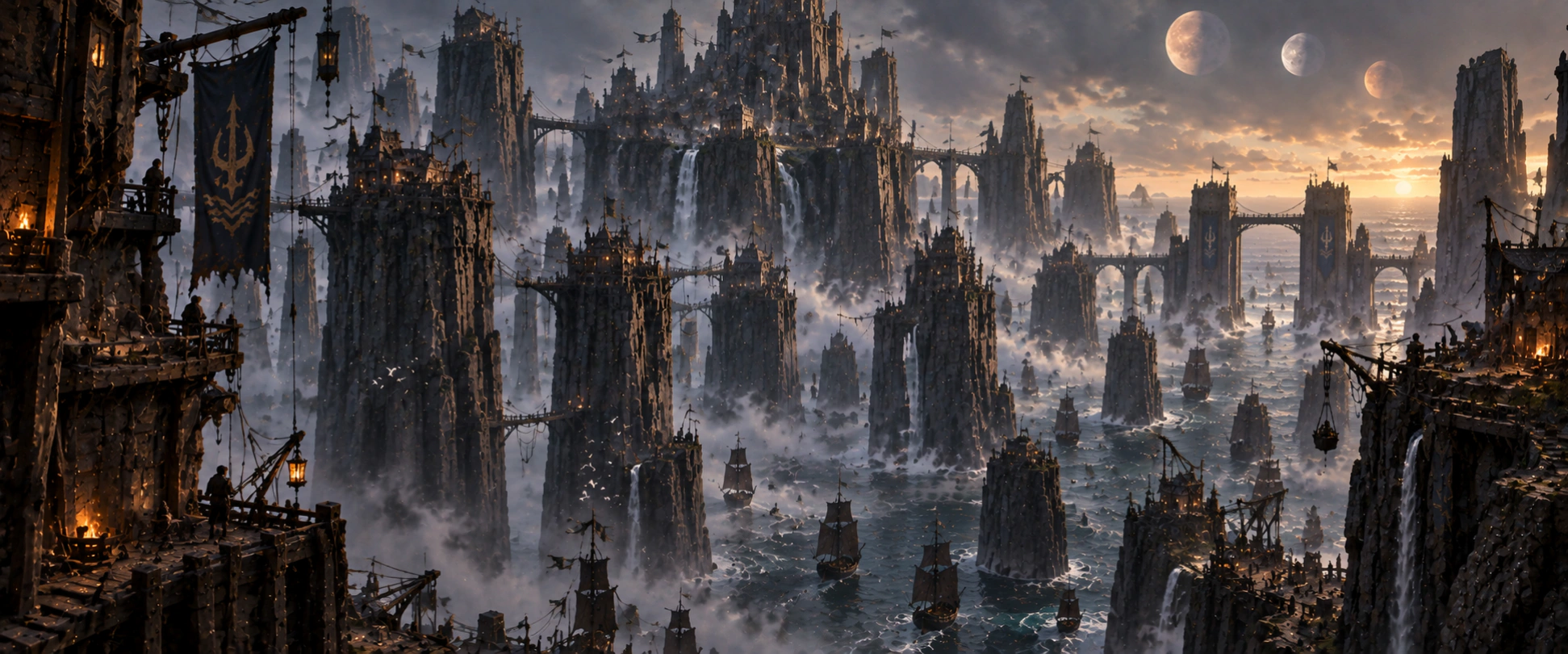
The Shattered Steps are a maritime federation occupying the broken south-eastern coastline of Manullyn. Named for the extraordinary basalt formations upon which much of its civilisation has been built, the region encompasses a vast coastal basin filled with thousands of stone pillars, islands, channels and ravines stretching approximately thirty miles inland from the open sea.
Across more than a thousand years of settlement, the peoples of the Steps have transformed this difficult landscape into one of the greatest maritime centres in Manullyn.
Cities climb the sides of basalt columns hundreds of feet above the water. Bridges span the spaces between them. Harbours and shipyards occupy the channels below, while cranes, lifts and endless stairways connect settlements built across multiple elevations. Boats fulfil many of the functions that roads perform elsewhere, carrying people and goods between communities separated by water, cliffs and open air.
Fog is common throughout the basin, sometimes obscuring entire districts and reducing visibility along the waterways to only a few dozen feet. Networks of beacons, bells and great stone horns allow sailors to navigate even when familiar landmarks disappear completely from view.
At the mouth of the basin stands Vauld, the colossal Sea Gate of Greymouth. Constructed over more than half a century, Vauld remains one of the greatest engineering achievements of the Fifth Era and one of the most recognisable structures in Manullyn. Beyond it lies the open sea.
Overview
The Shattered Steps are built upon one of the great Marks of Ending. Thousands of basalt columns rise from the coast and surrounding waters, ranging from small formations barely visible above the waves to immense pillars towering hundreds of feet into the air. Their precise origin remains unknown.
Unlike many Marks, however, the Steps are not inherently hostile to settlement. The earliest Fifth Era inhabitants established fishing communities amongst the lower reaches of the formations. Over successive centuries, improved engineering allowed settlement to spread upwards onto the pillars themselves, eventually producing the distinctive vertical towns and cities for which the region is known.
Modern political authority is exercised through the Federation of the Shattered Steps, which encompasses the great basin, surrounding coastal territories and a modest inland hinterland.
Five cities dominate the Federation. Port Lagrange is its largest city and political centre, occupying a dense network of inhabited columns within the inner basin. Pash is home to one of Manullyn’s great Arcane colleges and has become a centre of scholarship, engineering and magical study. Castle Noir is the principal naval stronghold of the Federation, containing its largest military shipyards and much of its permanent fleet. Fogwake stands at the inland edge of the Steps, where a great river plunges over the boundary of the basin. It serves as the primary connection between the maritime settlements and the agricultural and forested territories beyond. Greymouth guards the entrance to the basin and surrounds the colossal structure of Vauld.
Numerous smaller towns, villages, fishing communities and isolated settlements exist between and beyond these cities. The Five dominate Stepper politics and commerce, but they do not constitute the Federation alone.
Geography
The Shattered Steps form an enormous coastal basin where the land appears to have fractured into thousands of towering columns of dark basalt. Towards the open sea, the formations begin as scattered stacks and rocky islands battered by waves. Further into the basin they become progressively denser, forming narrow waterways, sheltered coves and forests of stone. Eventually, the pillars merge with the mainland. The result is a landscape where distinctions between land and sea are often unclear.
Settlements have adapted accordingly. At water level, docks, fisheries, warehouses, shipyards and workshops crowd the sheltered channels between pillars. Buildings are carved into or constructed against the basalt above them, while stairs, cranes, winches and counterweighted lifts provide access to higher elevations.
On the summits of the largest columns stand entire neighbourhoods. Bridges connect sufficiently close pillars, particularly within the great cities. Others remain accessible only by boat, lift or narrow stairways carved directly into the stone.
Port Lagrange represents the most extensive example of this style of settlement, its districts spread across numerous columns and elevations connected by a dense network of bridges and waterways.
Pash occupies some of the tallest formations within the basin, while Castle Noir is built around the dark fortifications and deep channels of the Federation’s principal naval harbour.
At the inland boundary lies Fogwake. Here a major river reaches the edge of the Mark before descending in a vast waterfall into the basin below. The city occupies both the upper and lower elevations, allowing goods arriving by road and river to be transferred onto the maritime network of the Steps.
Beyond Fogwake, the geography becomes considerably more conventional. Farmland, managed woodland and small villages occupy the Federation’s inland territories. These settlements provide much of the grain, livestock, timber and other resources required by the densely populated basin.
At the opposite end of the Steps stands Greymouth. The principal navigable entrance to the basin passes between two immense basalt formations upon which the fortifications and mechanisms of Vauld have been constructed. Beyond Greymouth, the pillars gradually disappear into open water.
Fog is common throughout the region. Its frequency has profoundly shaped Stepper navigation. Beacon towers use great fires and reflected light to mark important channels, while enormous horns positioned throughout the basin communicate warnings and navigational information through sound.
Experienced sailors can identify individual towers by the pitch of their horns and navigate familiar waters with little or no visibility. Foreign sailors frequently find this considerably less reassuring than the Steppers do.
Culture
Stepper culture is practical, maritime and strongly communal. Life within the basin requires constant cooperation. Bridges must be maintained, channels marked, ships rescued, fires watched and infrastructure repaired. Even the largest settlements depend upon resources and services provided elsewhere within the Federation.
This interdependence has shaped Stepper society since its earliest history. The phrase “Nobody survives alone” is commonly associated with the region, although whether it originated as an actual historical expression or simply became attached to Stepper culture later is uncertain.
Competence is highly respected. A skilled shipwright, navigator, engineer or fisher may command considerable social standing regardless of ancestry. Wealth is welcomed, but conspicuous display is often regarded less favourably than evidence that money has been put to practical use.
Stepper settlements consequently tend towards a weathered appearance even where substantial wealth exists. Black basalt, damp timber, iron fittings, ropes, cranes and working docks dominate much of the architecture. Buildings are repaired repeatedly rather than replaced merely for fashion, and infrastructure constructed centuries ago often remains in service alongside newer additions.
The Steps are not an austere society. Taverns, communal meals, markets and celebrations form important parts of local life, particularly during the long periods of poor weather that make outdoor work difficult. Traditional cuisine relies heavily upon fish, shellfish, preserved foods, dense breads and produce brought from the inland territories. Stepper humour is frequently dry, and outsiders sometimes mistake reserve for hostility.
The sea is present throughout everyday life. Children raised within the basin commonly learn basic swimming, knots and boat handling at an early age. Sailors, fishermen and harbour workers are ordinary parts of most communities, while shipwreck and death at sea remain familiar cultural realities.
Those whose bodies cannot be recovered are commonly commemorated using personal possessions in place of remains. Names of lost sailors can be found carved into harbour walls, beacon towers and memorial stones throughout the Federation.
The Steps also possess a comparatively relaxed attitude towards Arcane magic. Spellcasters have participated in Stepper society for centuries, particularly through the scholarly institutions of Pash. Magic is treated less as something inherently mysterious than as a specialised field requiring knowledge, discipline and competence.
This does not imply recklessness. A Stepper may be considerably more interested in whether a wizard is qualified to alter the enchantments of a bridge than in the philosophical question of whether the bridge should be enchanted at all.
Trade
The Shattered Steps are one of the great maritime trading centres of Manullyn. Their economy is built primarily upon fishing, shipping, shipbuilding, skilled manufacture and the movement of goods between sea and land.
Stepper shipyards are particularly renowned. Vessels constructed within the Federation possess a reputation for excellent craftsmanship, and foreign merchants, nobles and governments frequently commission ships from Stepper yards. Castle Noir contains the largest naval shipyards, although commercial shipbuilding occurs throughout the basin.
A substantial network of industries supports them. Rope, sailcloth, anchors, navigational instruments, metal fittings, maps and other maritime equipment are produced throughout the region. Stepper navigators and pilots are similarly respected, particularly for their ability to operate safely in difficult coastal waters.
Pash provides another important export: expertise. Engineers, architects, surveyors and Arcane specialists trained within the city are employed far beyond the Federation. Stepper knowledge of bridges, harbours, structural reinforcement and maritime construction is particularly highly regarded. The Federation also possesses substantial fishing grounds. Fish and shellfish provide a major component of local diets, while smoked, salted and otherwise preserved products are exported elsewhere.
Despite its prosperity, the basin itself cannot provide all the resources required by its population. Food arrives continually from the inland territories surrounding Fogwake and through foreign trade. Timber is especially important. Shipbuilding, construction and ordinary domestic life consume enormous quantities, leading the Federation to maintain managed forests outside the basin while importing specialised woods from elsewhere.
Metals, agricultural goods and raw materials likewise arrive in substantial quantities. The Steps frequently export these materials again in considerably more valuable forms.
This has produced a common description of Stepper commerce: the Federation imports what others possess and exports what Steppers can make from it. Foreign vessels regularly call at Port Lagrange even when the Steps are not their final destination. Safe harbours, skilled repairs, supplies, pilots and access to reliable charts make the basin a natural stopping point for maritime traffic. All foreign vessels entering the principal basin pass through Greymouth, and beneath Vauld.
Religion
Worship of the Fifteen is practised throughout the Shattered Steps. Stepper religion is generally uncomplicated by unusual regional theology. Temples, shrines and household worship vary between communities and individuals, and no single deity possesses formal supremacy within the Federation.
Three gods are particularly prominent:
Oros, god of wilderness, storms and oceans, is widely honoured amongst sailors, fishermen and those whose livelihoods depend upon the sea.
Temenos, god of craftsmanship, invention and creation, enjoys substantial devotion amongst shipwrights, masons, engineers and other skilled trades.
Caelene, associated with travel, freedom and the open road, is popular amongst sailors, navigators, merchants and travellers.
Their prominence does not constitute a formal Stepper triad, and worship of other members of the Fifteen is entirely ordinary. Moraeth possesses particular importance within funerary traditions associated with those lost at sea, while Aurelia is frequently invoked by healers and rescue crews.
Religious practice tends to reflect the practical character of Stepper society. Small shrines are common aboard ships, within workshops and beside bridges. Temples in major cities frequently maintain relationships with particular guilds, neighbourhoods or maritime communities.
Vauld itself has accumulated numerous religious traditions over the centuries, but the structure is not regarded as a temple or sacred object. It was built by mortals, and for many Steppers that is impressive enough.
History
The First Settlements
Permanent Fifth Era settlement of the Shattered Steps began around 350 FE. The earliest communities were established at the bases of the basalt formations, where sheltered waters and rich fishing grounds provided reliable sources of food.
These settlements remained small. Travel between them depended heavily upon boats, and the fractured terrain made expansion inland or between neighbouring communities difficult. Early Stepper society therefore developed around fishing, local maritime trade and the exploitation of resources found throughout the basin.
For several generations, settlement remained concentrated close to the water, but this changed in 432 FE. During that year, the first permanent structure was erected upon the summit of one of the great pillars. The achievement demonstrated that sustained habitation at the higher elevations was possible.
Further construction followed. Stairways were carved into stone. Primitive cranes and lifts transported materials upwards. Bridges began connecting neighbouring formations. The settlement surrounding the original pillar expanded rapidly, and would eventually become Port Lagrange.
The First Compacts
For much of the following century, Stepper settlements remained politically independent. Cooperation existed where necessary. Fishing grounds were shared, vessels rescued one another and informal agreements governed access to particular channels.
The Guerre Locris changed this. In 516 FE, the wider Locrian advance brought armed forces into contact with settlements around the Steps. The region was never the principal theatre of the war, but even limited encounters demonstrated how vulnerable the isolated communities were to organised military power.
Several settlements responded by drafting agreements for mutual defence. These became known collectively as the First Compacts.
Among the most influential were the Compact of Safe Harbour, requiring signatories to provide refuge and assistance to allied vessels, and the Blackwater Compact, through which ships, crews and resources were pledged to common defence. A permanent fortified position was established to coordinate these efforts. This stronghold became Castle Noir.
The immediate Locrian threat eventually passed, but the principles of the Compacts remained. Over subsequent decades, agreements expanded beyond military defence. Settlements established common rules governing salvage, navigation, harbour access, rescue obligations and the maintenance of shared infrastructure.
The political foundations of the modern Federation emerged gradually from these arrangements. No single agreement created the Shattered Steps. The Steppers simply continued signing them until separation became increasingly impractical.
The Founding of Pash
By the sixth century FE, the unusual geography of the Steps had begun attracting scholarly attention. The basalt formations were recognised as a Mark of Ending, but little was understood about their age, creation or unusual properties. In 587 FE, a small expedition of scholars and Arcane practitioners established a permanent research encampment amongst some of the tallest pillars in the basin. Their purpose was to study the Mark.
The encampment gradually became permanent. Laboratories replaced tents. Libraries were established. Workshops supported increasingly sophisticated research, while apprentices travelled to the settlement to study beneath experienced practitioners. Eventually, a town grew around them, which would become Pash.
Over the following centuries, the institution expanded far beyond its original purpose. Teaching increasingly accompanied research, while subjects unrelated to the Mark were incorporated into its curriculum. The original research station eventually became one of the great Arcane colleges of Manullyn.
Modern Pash teaches a broad range of Arcane disciplines and attracts students and scholars from across the continent. Study of the Shattered Steps remains only one field amongst many.
Fogwake and the Opening of the Interior
By the beginning of the seventh century, tales of the resources, fisheries and growing settlements of the Shattered Steps had spread far beyond the basin. Trade increased rapidly, yet the greatest obstacle remained access to the mainland.
In 602 FE, permanent settlement was established around the point where a major river reached the inland boundary of the Mark and plunged into the basin below. The resulting settlement became Fogwake.
Fogwake developed simultaneously above and below the falls. Roads and river traffic delivered goods to the upper city, while docks within the basin allowed cargo to continue onwards by ship.
The city became the great hinge between the Steps and continental Manullyn. Timber, food, livestock and raw materials flowed into the basin. Ships, manufactured goods and maritime products travelled outward. The opening of Fogwake began a period of extraordinary economic expansion.
The Great Expansion
During the seventh century FE, the scattered Compacts increasingly developed into permanent institutions.
Port Lagrange became the principal commercial and political centre of the basin. Castle Noir expanded into a permanent naval stronghold. Pash became increasingly influential amongst engineers and Arcane practitioners, while Fogwake connected the maritime settlements to growing inland trade.
Smaller communities continued to join the network. Shared navigation signals were standardised. Beacon towers were constructed throughout the channels. Common maritime laws developed from earlier salvage and rescue agreements.
The first permanent councils of settlement representatives emerged during this period. Modern historians disagree on when the Federation of the Shattered Steps formally came into existence. Several dates have been proposed, but Stepper government has never considered the question particularly urgent.
Vauld
By the middle of the seventh century, the basin had become one of the busiest harbours in southern Manullyn, but its entrance remained vulnerable. Around 660 FE, the Federation approved the construction of a structure intended to secure the principal mouth of the Steps. The project would consume more than half a century. The structure was called Vauld.
Two immense fortified complexes were constructed around the basalt formations flanking the entrance to the basin. Within them, enormous mechanisms of chains, counterweights, capstans and barriers were built capable of closing the navigable channel to hostile shipping. Its construction required resources from throughout the Federation. Port Lagrange provided administration, finance and labour. Castle Noir supplied naval logistics, metalworking and shipbuilding expertise.
Fogwake carried vast quantities of timber, food and raw materials into the basin. Pash provided engineers and Arcane specialists whose work in structural reinforcement, materials and magical analysis proved essential to solving problems encountered during construction.
Thousands worked upon Vauld, some spending their entire careers doing so. The settlement required to house its labourers, engineers, sailors and administrators grew rapidly around the construction site. It became Greymouth.
In 713 FE, Vauld was completed. For the first time, its mechanisms were engaged and the mouth of the Shattered Steps was closed.
Tradition holds that the great horn at Greymouth sounded first. Castle Noir answered, then Port Lagrange. then Pash. Then countless smaller towers throughout the basin, until the sound finally reached Fogwake. Whether every detail of the story is true is uncertain. The date nevertheless marks one of the defining moments of Stepper history: the basin was no longer simply a collection of settlements connected by agreements. It was a nation.
Beyond the Basin
The centuries following the completion of Vauld saw the Federation expand its influence beyond the immediate confines of the Mark. Settlement spread through the lands surrounding Fogwake and along the neighbouring coastline. Agricultural villages were founded or incorporated into the Federation. Roads connected inland communities to Fogwake, while managed forests provided increasingly important supplies of timber for shipbuilding and construction. Smaller ports and fishing settlements developed beyond the principal basin.
This expansion was generally gradual. Land was settled, purchased, negotiated over and occasionally contested. Fortifications and administrative boundaries eventually established a recognised territorial frontier around the Federation.
By the later Fifth Era, the modern extent of the Shattered Steps was largely recognisable. These territories remain less densely populated than the basin but are essential to its survival. They provide the farmland, forests and resources upon which the spectacular cities of the Steps depend.
The Maritime Ascendancy
The centuries following the completion of Vauld were characterised by the gradual consolidation of the Federation. Its navy became one of the foremost maritime forces in Manullyn. Stepper shipwrights developed an international reputation, Port Lagrange grew into one of the continent’s great ports, and Pash expanded far beyond its original purpose to become one of the principal centres of Arcane scholarship in the Fifth Era.
The Federation did not remain entirely untouched by conflict. Naval wars, piracy, commercial disputes and periods of political crisis punctuated its later history. Fires consumed districts, storms destroyed settlements and bridges occasionally fell into the waters beneath them. None fundamentally disrupted the Federation.
The greatest challenge to Stepper power since its foundation came much later, with the arrival of the Pale Fleet.
The Pale Fleet
For much of its history, piracy in the southern seas had consisted of independent captains and small flotillas. Such vessels presented a persistent threat to merchant shipping but rarely possessed the organisation or numbers required to challenge established naval powers.
This changed under Silas Rook. An exceptionally successful pirate captain and naval commander, Rook achieved what had previously been considered nearly impossible: he brought dozens of independent pirate captains beneath a single command.
The resulting armada became known as the Pale Fleet, named for the bleached and largely unmarked sails carried by many of its vessels. At its height, the fleet numbered well over a hundred ships, including captured merchantmen, raiders, transports and former naval vessels.
At its centre sailed Rook’s flagship, Mercy. Originally constructed as a warship, Mercy had been captured years earlier and retained its former name. Its weathered figurehead depicted a woman extending one hand towards the sea. Rook never renamed the vessel.
By the time the Pale Fleet reached the Shattered Steps, Mercy had become one of the most feared ships in the southern seas. Rook’s ambitions extended beyond raiding merchant shipping. The wealth concentrated within Port Lagrange, the shipyards of Castle Noir and the protected waters of the basin offered a prize unlike any other. He intended to seize them.
The Defence of the Steps
The Pale Fleet appeared off Greymouth in numbers unprecedented in the history of southern piracy. Rook understood that the Federation could not be defeated simply by sailing through its principal entrance. His attack therefore targeted the entire defensive system surrounding Greymouth and Vauld.
While the main fleet approached the Gate, smaller vessels attempted to penetrate lesser channels. Landing parties were dispatched against the outer pillars and fortifications. Fireships accompanied the assault, while other forces attempted to reach the mechanisms controlling Vauld itself.
Before the attack began, Rook is traditionally said to have sent a message to Greymouth containing only two words: Open Vauld.
Whether the wording recorded in later histories is exact remains disputed, but the response is not. Greymouth sounded its horn, and Vauld began to close. Across the basin, beacon towers and foghorns repeated the warning until every settlement within the Steps understood what was approaching. The resulting conflict became known as the Defence of the Steps.
The Federation possessed fewer vessels than Rook’s assembled fleet, but the Pale Fleet was forced to fight within waters its opponents had navigated for generations. Beacon patterns were altered. Channels were deliberately obstructed. Stepper pilots guided warships through passages unfamiliar to the attackers, while smaller vessels struck from amongst the pillars before disappearing again into the fog. The same network of horns used for centuries to guide shipping became a system of naval communication. To the Pale Fleet, the basin was a maze. To the defenders, it was home.
Castle Noir’s fleet bore the principal naval fighting, while vessels from across the Federation were pressed into service carrying supplies, evacuating civilians and transporting troops. Pash provided Arcane specialists to reinforce vulnerable infrastructure, assist communication and advise the defenders on weather and visibility. At Greymouth, sailors, marines, militia, engineers and dockworkers prepared Vauld itself for attack.
The Battle of Vauld
Rook eventually concentrated the Pale Fleet against the principal entrance to the basin. The ensuing Battle of Vauld became the largest naval engagement in the history of the Federation.
The Gate did not emerge untouched. Fireships struck its outer defences. Sections of the mechanisms were damaged under sustained attack, and one assault succeeded in landing a substantial pirate force upon the fortifications themselves.
For a time, fighting took place directly upon Vauld. Later Stepper histories have frequently romanticised the battle as an inevitable triumph. Contemporary accounts suggest otherwise.
The defence came dangerously close to failure. Rook’s plan was sufficiently sophisticated that later generations of naval officers at Castle Noir continued to study the battle, not as an example of pirate recklessness, but as a serious attempt to overcome the Federation’s defences.
It failed because those defences did not depend upon any single element. When mechanisms failed, engineers repaired them. When positions were overwhelmed, reinforcements arrived by boat. When the fleet was forced backwards, smaller vessels continued fighting amongst the channels. When visibility collapsed, Stepper captains navigated by horns and local knowledge.
The defence of Vauld became, in later histories, the defining demonstration of the principle upon which the Federation had been built centuries earlier:
Nobody survives alone.
The pirate forces occupying the Gate were eventually driven back. With the entrance to the basin closed and the assault faltering, cohesion within the Pale Fleet began to collapse. Some captains withdrew independently. Others surrendered or attempted to escape into open water. Castle Noir’s surviving warships pursued them.
Over the following days, vessels of the Pale Fleet were captured, destroyed or scattered across the southern seas. The coalition Rook had assembled never recovered. Organised piracy throughout the region declined dramatically for a generation afterwards. The ultimate fate of Silas Rook and Mercy became inseparable from the history of the battle.
Legacy
The Defence of the Steps remains the most celebrated military victory in modern Stepper history. Damage inflicted upon Vauld was repaired, although several scars from the battle were deliberately preserved. They remain visible upon the Gate today. The victory also reinforced the Federation’s reputation as one of the foremost maritime powers in Manullyn. Its significance, however, extends beyond naval history.
Today, the Shattered Steps remain among the most prosperous maritime powers of the Fifth Era. Stepper tradition frequently describes the basin as the greatest port in the world.