The Locrian Expanse
Contents
 Manullyn
Overview
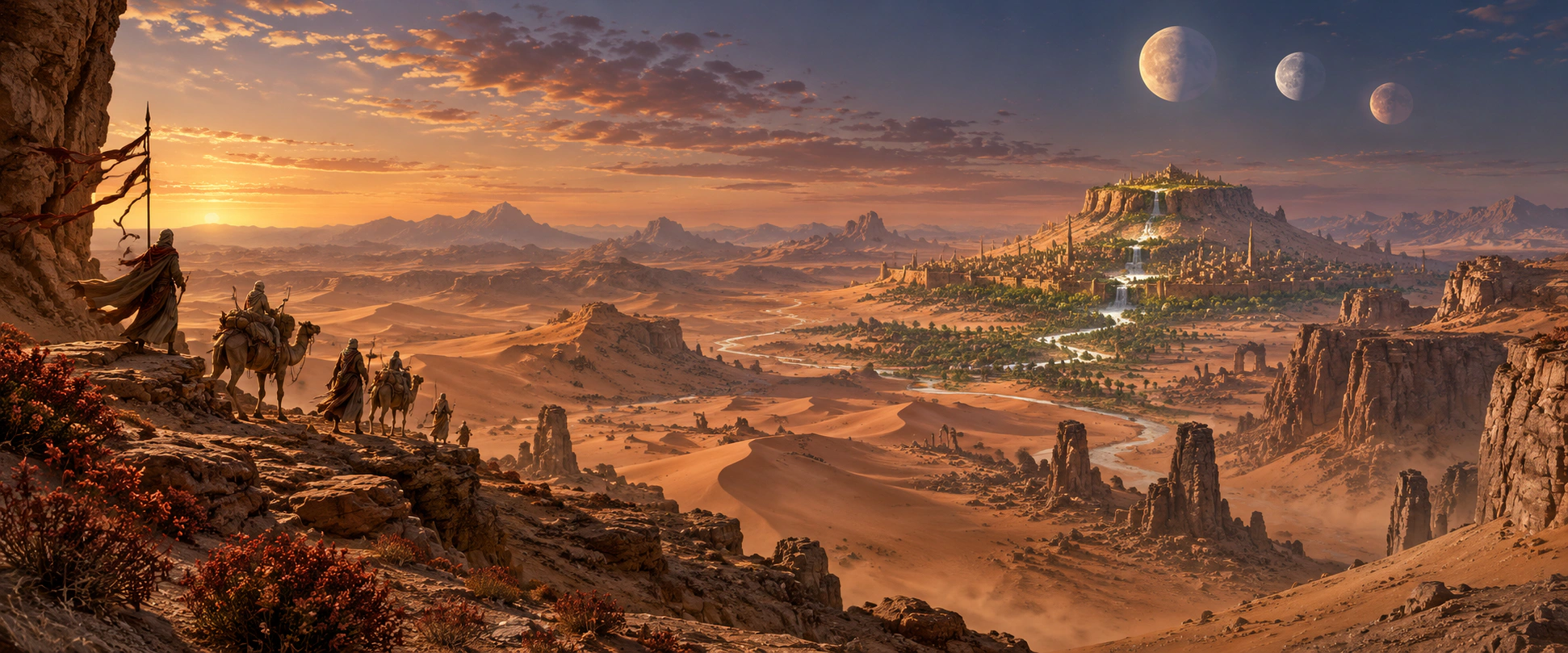
The Locrian Expanse is an arid region occupying the western reaches of Manullyn, formed of vast dunes, barren badlands, sheer sandstone cliffs and stretches of land in which almost nothing grows. The region is infamous not only for its dramatic and inhospitable landscape, but for the reputation of its people, known throughout much of wider Manullyn as Wasters.
Around five centuries after the Fourth Ending, this reputation was cemented by a devastating holy war known as the Guerre Locris. For sixteen years, previously divided peoples of the Expanse crossed the mountains and canyons separating their homeland from wider Manullyn and waged a campaign of conquest across the lands beyond. Only through the efforts of a kingdom that has itself long since disappeared were the Locrian armies eventually defeated and driven back into the west.
The Guerre Locris ended almost a thousand years ago, but its memory continues to shape perceptions of the Expanse and its inhabitants. Tales of fanatical Waster armies have been exaggerated through centuries of retelling, and the Locrians of the present day bear little resemblance to the people imagined in stories told about them.
Geography
The great dunes of the Expanse can be extraordinarily difficult to navigate. Sandstorms reshape familiar terrain, trails disappear within hours and few permanent roads exist beyond the immediate surroundings of major settlements.
Caravans, messengers and other travellers instead navigate using reliable geographical features alongside the positions of the sun, stars and the Three Moons.
Most journeys are undertaken on foot, although beasts native to the Expanse have been tamed by some cultures as mounts, pack animals and companions. Different communities have developed their own methods of crossing the desert, and the routes considered safe by one people may be virtually unknown to another.
Water determines much of the geography of civilisation. Wells and aquifers can sustain settlements far from visible rivers, while reliable springs may become important stopping points along routes stretching for hundreds of miles. Knowledge of such places is invaluable, and intentionally concealing or destroying a source of water is regarded with particular severity in many Locrian cultures.
The most famous landmark in the region is the Garden of Ameterasu, one of the great Marks of Ending. An impossible river flows uphill through the desert towards a vast and verdant oasis, sustaining an abundance of life otherwise unknown within the surrounding wastes.
Built around the Garden is Sarrakar, the largest and most influential city of the Expanse. Foreign maps frequently describe Sarrakar as the Locrian capital, although this description has little political meaning within the region itself. Sarrakar governs neither the Expanse nor its many peoples, and inhabitants of other Locrian settlements may regard the suggestion that it does with some amusement.
Culture
Hardship has shaped the cultures of the Expanse, but the common image of Locrians as savage or brutal bears little resemblance to most modern communities. Hospitality is amongst the most widespread customs shared between otherwise distinct Locrian peoples. In a land where an unfamiliar traveller may genuinely die without assistance, providing food, water and shelter carries significance beyond ordinary politeness.
A visitor entering a Locrian home may therefore be offered water before even being asked their name. Accepting such hospitality creates an expectation of peaceful conduct between guest and host, while refusing it can be interpreted as distrust, insult or even an indication of hostile intent. Customs vary considerably, but deliberately harming someone whose hospitality has been accepted is regarded as particularly contemptible in many parts of the Expanse.
These traditions exist alongside cultures perfectly capable of warfare, rivalry and violence. Locrian hospitality does not necessarily imply friendship. Rather, it represents a shared understanding that survival in the Expanse sometimes requires obligations that transcend ordinary hostility. Locrians travelling beyond their homeland often encounter a very different attitude.
The Guerre Locris remains one of the defining images of the Expanse throughout wider Manullyn. Wasters are variously stereotyped as fanatical, violent, primitive or possessed of almost inhuman endurance. Stories about the ancient invasion remain disproportionately prominent in foreign accounts of Locrian history, despite representing only a small portion of the region’s past.
For many modern Locrians, the continued association is a source of frustration. Others have embraced the Waster name themselves, particularly when travelling abroad, and its meaning varies considerably according to speaker and circumstance.
Trade
Despite the distances separating it from the great commercial centres of Manullyn, the Expanse participates extensively in long-distance trade. Locrian caravans carry silks, rare plants, metals and other valuable goods through the mountain passes and onwards into wider Manullyn. Goods from distant lands return along the same routes, and generations of merchants have established commercial relationships far beyond the wastes.
One particularly controversial export is the seed of the native Redthorn Bush. Within the Expanse, Redthorn seeds are traditionally ground into a powder, mixed with desert tobacco and smoked recreationally. The practice is widespread enough in some communities to be considered unremarkable.
Foreign alchemists discovered that Redthorn can be heavily refined into Morthis, a powerful and dangerously addictive narcotic. Morthis itself is rarely encountered within the Expanse, but has become notorious within criminal markets elsewhere in Manullyn.
The distinction is frequently lost in foreign perceptions of Locrian traders, who are sometimes accused of bringing Morthis into eastern cities despite generally trading only in the unrefined plant. This does not prevent less scrupulous merchants from knowingly profiting from the foreign narcotics trade.
Religion and the Three Moons
The Fifteen are worshipped throughout the Locrian Expanse, although religious practice differs significantly from that found across much of Manullyn. Individual gods are recognised, invoked and worshipped, but Locrian traditions commonly understand them through their relationship with the Three Moons: Cresta, Pollux and Urd.
Cresta is associated with the five Concordant Gods, Pollux with the five Unbound Gods, and Urd with the five Adversarial Gods. Together, the Three are regarded as visible expressions of the great spectra of divine influence within creation.
The moons themselves are not generally considered gods. Rather, their endless passage through the sky serves as a reminder that the influences represented by all Fifteen exist simultaneously within the world and within mortal beings.
This produces one of the most distinctive features of Locrian theology. The morality of a deity has considerably less influence upon whether that deity should be acknowledged. The Adversarial Gods are not regarded as benevolent, nor are cruelty, greed, tyranny or violence considered virtuous simply because gods embody them. Instead, such forces are understood as genuine components of reality that cannot be overcome merely by pretending they do not exist.
A person may recognise Malachar in their own greed, Korvath in their anger or Varkhul in their desire to control another. Religious practice encourages recognition of these impulses alongside those associated with the Concordant and Unbound Gods.
Consequently, imagery associated with Urd or the Adversarial Five is neither inherently forbidden nor evidence of malicious intent. This practice has historically been misunderstood beyond the Expanse, where Locrian acknowledgement of Adversarial deities is sometimes interpreted as open devotion to Evil gods.
Shrines and religious imagery frequently represent the Three collectively rather than a single deity. Lunar phases, threefold symbols and representations of balance between Cresta, Pollux and Urd are common features of Locrian religious art. Their importance is also deeply practical.
For countless generations, travellers have used the Three Moons to navigate across a landscape largely devoid of roads. Their predictable passage through the heavens provides direction to caravans, messengers and wanderers crossing the wastes. Religion and survival have consequently become intertwined around a simple idea found in numerous forms throughout the cultures of the Expanse:
The Three show the way.
Individual devotion remains neither controversial nor unusual. A worshipper may develop a particular relationship with one of the Fifteen while continuing to observe broader lunar traditions. This is particularly common amongst clerics. Divine power is bestowed by the gods rather than acquired simply through religious study, and a Locrian chosen by one of the Fifteen may subsequently develop a much more personal devotion to that deity. For such clerics, individual worship can therefore be the result of divine calling rather than its precursor.
Historical Overview
The Early Fifth Era
The Fourth Ending devastated the Expanse. Already one of the most inhospitable regions of Manullyn, the ecological disruption following the eruption of Grey Mountain made survival considerably more difficult. Springs disappeared, aquifers shifted, established routes became impassable and communities that had depended upon trade with distant settlements suddenly found themselves isolated.
Precisely how many people survived the Ending is unknown. Sarrakar and the Garden of Ameterasu provided one of the region’s most reliable centres of habitation, while elsewhere communities gathered around surviving rivers, wells, aquifers and oases. Many smaller settlements disappeared entirely.
The centuries that followed were characterised by persistent competition for resources. Water became inseparable from political power. Wells were fortified, caravan routes contested and access to reliable sources of water used as leverage between neighbouring communities. Raiding became commonplace in some areas, while blood feuds between tribes and settlements could persist across generations.
This period was not one of continuous warfare. Trade continued, alliances were formed and many of the customs now associated with Locrian society can trace some part of their origins to the Early Fifth Era. Nevertheless, relations between the peoples of the Expanse were considerably more hostile than those of the present day. The survival of one community could easily come at the expense of another.
The Mithraq
Around the fifth century of the Fifth Era, Arazhan Sareth emerged as one of the most influential figures in Locrian history.
The precise circumstances of Sareth’s early life are obscured by later religious tradition and political mythology. Accounts variously describe them as a warrior, prophet, mediator, tribal leader or some combination of the four. What is generally accepted is that Sareth rose to prominence during another period of conflict between the peoples of the Expanse and began preaching that continued division would eventually destroy them.
Sareth’s earliest successes came through diplomacy. Long-standing disputes over wells were settled, agreements governing caravan routes were established and rival communities were persuaded to recognise common protections for travellers. These agreements allowed trade to flourish across territories where merchants had previously travelled at considerable risk.
Not every community joined willingly. Where negotiation failed, Sareth proved equally capable of conquest. Settlements that resisted incorporation were defeated, rival leaders removed and control of strategically important water sources brought beneath the authority of the growing confederation. Within a generation, much of the Expanse recognised Sareth’s authority.
For the first time in recorded Fifth Era history, travellers could cross enormous portions of the western wastes under a broadly shared system of protections. Raiding declined, trade expanded and Sarrakar developed into the political and spiritual centre of the new order.
Many customs now regarded as characteristic of Locrian culture became widespread during this period. Traditions governing hospitality, shared access to water and the protection of travellers existed beforehand, but their adoption across previously unrelated communities accelerated considerably under the Mithraq. To generations that had known conflict over the necessities of survival, Sareth appeared to many as a saviour. The peace would not last.
The Guerre Locris
The Guerre Locris was a sixteen-year conflict fought during the fifth century of the Fifth Era, beginning when the recently unified peoples of the Locrian Expanse crossed the mountain passes into wider Manullyn.
It remains one of the most infamous conflicts of the early Fifth Era. The war transformed Arazhan Sareth from the unifier of the Expanse into one of the most controversial figures in its history, destroyed the kingdom principally responsible for stopping the Locrian advance, and created many of the stereotypes surrounding the Locrian peoples that survive into the present day.
After the Guerre Locris
The defeat of the Locrian armies during the Guerre Locris ended any realistic prospect of maintaining the unified state created by Sareth. The surviving armies returned to an Expanse depleted by sixteen years of warfare. Entire generations had spent their lives supporting the campaign, and numerous communities had lost significant portions of their population.
Without the authority that had held the confederation together, its political structure gradually fractured. Individual settlements reasserted their independence. Tribal leaders reclaimed powers surrendered during the Unification. Sarrakar retained considerable influence but never established permanent sovereignty over the wider Expanse.
The region did not, however, return to the conditions that had preceded Sareth. The networks created during the Unification endured. Agreements concerning water survived the state that had enforced them. Caravan routes remained in use, and customs of hospitality increasingly crossed boundaries between communities. In the centuries following the war, these practices became traditions in their own right.
The Guerre Locris also fundamentally changed Locrian attitudes towards political unity. Although alliances and regional confederations have arisen repeatedly since, no individual ruler has again commanded the allegiance of the Expanse as a whole. Attempts to claim such authority are often regarded with suspicion, and the memory of the Unification serves simultaneously as proof of what cooperation can achieve and a warning of what can occur when too much authority is placed in a single figure.
The Modern Expanse
Over the following millennium, the Expanse developed into the culturally diverse region that exists today. Cities expanded around reliable sources of water. Caravan networks connected distant settlements. Trade across the mountain passes resumed, and Locrian merchants became familiar sights in markets far beyond their homeland.
Sarrakar remained the largest and most influential settlement in the region, particularly because of its relationship with the Garden of Ameterasu. Foreigners increasingly described it as the capital of the Expanse, despite the absence of any political structure through which it could claim such a title.
The millennium following the Guerre Locris has contained wars, droughts, political upheavals and local conflicts, but no comparable attempt to unite the Expanse or conquer the lands beyond it. Nevertheless, beyond the western mountains, the sixteen years of the Guerre Locris continue to overshadow almost every other period of Locrian history.