Cairnborn
Contents
 The Crownlands
Overview
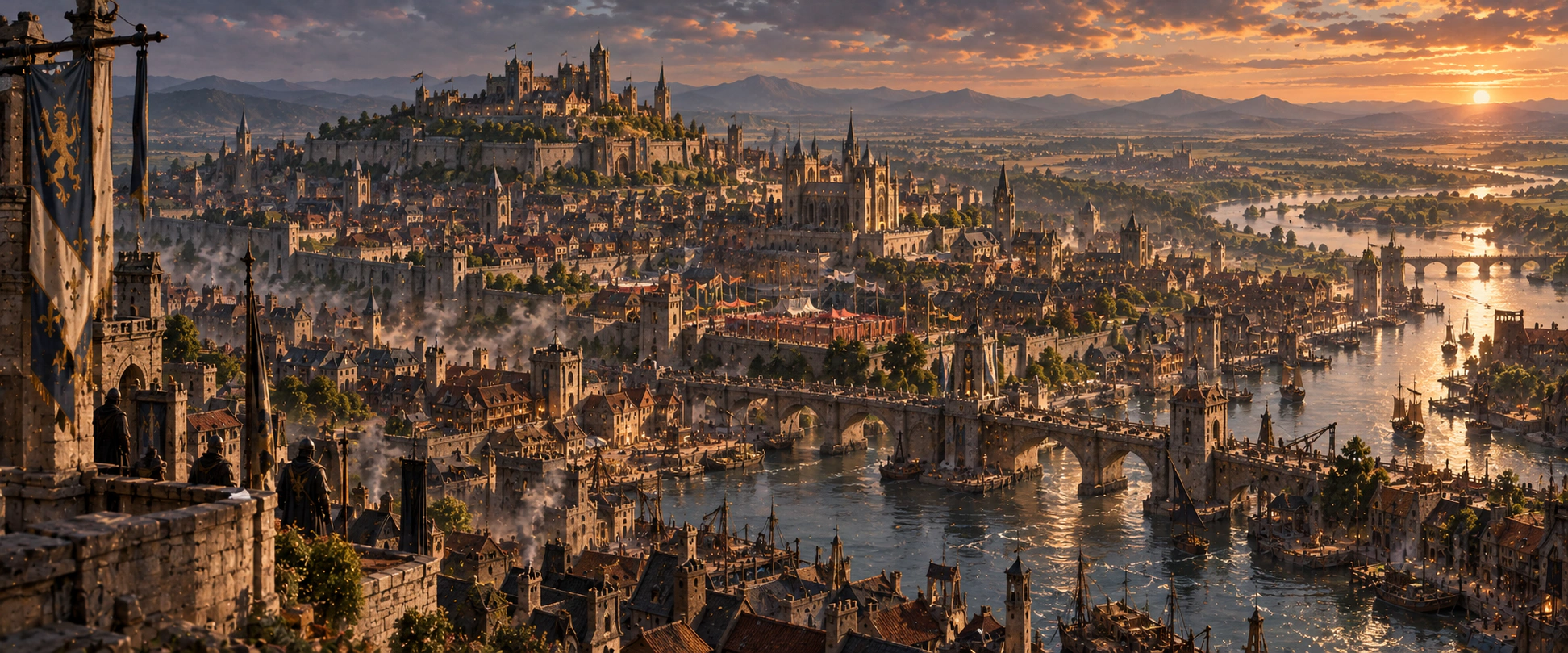
Cairnborn is the capital of the fiefdom of the same name and one of the principal cities of the Crownlands. Home to approximately 150,000 people, it rises above the Wexford River amid some of the most fertile land in Manullyn.
The city is regarded as the birthplace of the Lesterian Empire. From Cairnborn, Aldrich Lester began the Unification Crusade that brought the Crownlands beneath the Iron Crown. Though the Empire has been gone for centuries, its legacy remains inseparable from the city’s identity.
Cairnborn is today ruled by Duke Pierre Davenant, whose dynasty has governed the city for longer than House Lester itself. It remains wealthy and influential, supported by rich farmland, renowned horses and brewing, a professional army and centuries of stable government.
Geography
Cairnborn occupies a series of slopes overlooking the Wexford River, which eventually reaches the Tyrethian Sea at Merrowyn. The city developed outwards and downhill over many centuries, with its age and social history reflected in its layout.
At its summit is the Crown, home to Greenkeep and the institutions of ducal government. Below lies Old Cairn, the dense heart of the original city. Further downhill are the Lists, traditionally associated with Cairnborn’s knights; the Muster, containing much of its military infrastructure; and the Mercers, its principal commercial district.
Beyond the later city walls lies Harrowfield, once a separate village and now a sprawling working district extending towards and across the Wexford. Beyond it, Cairnborn quickly gives way to farmland, pasture and hunting estates.
Government
Cairnborn is a hereditary duchy ruled by House Davenant, which succeeded the Lesters during the gradual dissolution of the old Empire. The precise circumstances of their accession remain murky, but Davenant rule has been secure for centuries.
The current ruler, Duke Pierre Davenant, is a human man in his late fifties with a reputation for firm but fair government and genuine concern for the welfare of his subjects. His husband, Michel, is closely associated with Cairnborn’s artistic and charitable life. They have one adopted daughter.
A Council of Magistrates, all sworn to the Duke, oversees much of the everyday administration of the fiefdom. Magistrates govern districts of Cairnborn and territories beyond the city, administer law and taxation, and oversee the lesser noble houses holding hereditary titles over Cairnborn’s towns and villages.
Culture
Cairnborn is a city of chivalry, horsemanship and considerable civic pride. Knightly houses remain prominent, and the romantic ideal of the armoured Crownlander knight is perhaps nowhere cultivated more enthusiastically.
Its greatest celebration is the Annual Tourney, held over two weeks in early summer. Jousting, melees, archery, wrestling, racing and other contests attract competitors and spectators from across the Crownlands, while celebrations spread far beyond the Grand Lists themselves.
Coronation Day commemorates Aldrich Lester’s coronation and the conclusion of the Unification Crusade. Formal observances at Lester’s Tomb give way to parades, bells, communal meals and festivities throughout the city.
Lester’s legacy remains ubiquitous in Cairnborn, although centuries of Davenant rule have created an equally substantial history of their own. Worship of the Fifteen is widespread, with temples and shrines scattered organically throughout the city.
Cairnborn maintains approximately 6,000 professional soldiers, known collectively as the Cairnborn Guard. In peacetime they serve as both soldiers and city guards; in war they form the core of the ducal army, supplemented by the knights and retainers of Cairnborn’s noble houses.
Trade
Cairnborn’s wealth is rooted in the fertile countryside surrounding it. Grain is produced in enormous quantities and supports a substantial brewing industry, while its pasturelands have made Cairnborn particularly renowned for horses.
Hunting is both economically and culturally important, particularly amongst the nobility, while generations of aristocratic and mercantile patronage have created a thriving artistic community of painters, sculptors, jewellers and other craftspeople.
The Wexford provides access downstream towards Merrowyn and the Tyrethian Sea, though Cairnborn remains primarily an agricultural and administrative centre rather than a major mercantile port.
History
Cairnborn rose to prominence under Aldrich Lester, who established his fiefdom here before launching the Unification Crusade. His eventual coronation and creation of the Iron Crown transformed Cairnborn from a regional stronghold into the birthplace of an empire.
Lesterian authority gradually declined after his death, eventually giving way to the independent fiefdoms of the modern Crownlands. The recognised Lester bloodline disappeared during this period, though surviving records of its final generations are incomplete and occasionally contradictory.
House Davenant subsequently assumed control of Cairnborn and has now ruled for centuries. Whatever uncertainty surrounds their original accession, their legitimacy in modern Cairnborn is rarely questioned. The ongoing war with the Eastern Reach and rumours that the Iron Crown may still exist have nevertheless brought Cairnborn’s ancient history sharply back into contemporary politics.
Points of Interest
Greenkeep
Greenkeep is the ancestral seat of House Davenant, standing at the summit of the Crown. Though heavily fortified, it is renowned for its beauty: moss and ivy cover portions of its old stonework while gardens, orchards, fountains and terraces fill the grounds within its walls. Parts of Greenkeep incorporate much older fortifications, including structures traditionally associated with Aldrich Lester’s original stronghold.
Lester’s Tomb
Located amongst the streets of Old Cairn, Lester’s Tomb contains the remains of Aldrich Lester. Deliberately situated outside Greenkeep and accessible to the public, it has become one of Cairnborn’s most important civic monuments. The tomb has been repaired and embellished repeatedly over the centuries and serves as the focus of formal observances during Coronation Day.
The Grand Lists
The Grand Lists are the centre of Cairnborn’s knightly culture. A great tiltyard surrounded by permanent galleries forms the heart of a larger complex of arenas, training grounds and competitors’ halls. During the Annual Tourney, temporary stands and pavilions spread throughout the surrounding district as the Lists host jousting, melees and numerous other competitions. The celebration culminates in the prestigious Grand Tilt.
Old Wexford Bridge
Old Wexford Bridge is the oldest surviving crossing of the Wexford River. Heavy stone arches carry a broad roadway across approximately 250–300 feet of water, with the remains of an old fortified gatehouse standing at the Cairnborn end. Centuries of floods, repairs and rebuilding mean almost every part of the bridge has been replaced at some point. Cairnborners nevertheless insist it remains the same bridge.
The Equine Holds
Situated on the outer edge of Harrowfield, the Equine Holds are the largest permanent horse-trading grounds in the Crownlands. Stable yards, paddocks, auction pens, training rings and farriers accommodate animals brought to Cairnborn from throughout the surrounding countryside. The Holds become particularly busy during the Annual Tourney, hosting horse fairs, racing and tests of horsemanship alongside their ordinary trade.
Gallowsgate
Gallowsgate is Cairnborn’s principal gaol, occupying an ancient fortified gatehouse converted into a prison as the city expanded beyond its old walls. Its name derives from the execution ground that once stood outside the gate. Criminals, captured enemies, political prisoners and disgraced nobles have passed through Gallowsgate over centuries, leaving the walls of its oldest cells covered in inscriptions. The prison remains in active use under the Magistracy, though several of its deepest sections have long since been sealed.