Highcourt
Contents
Overview
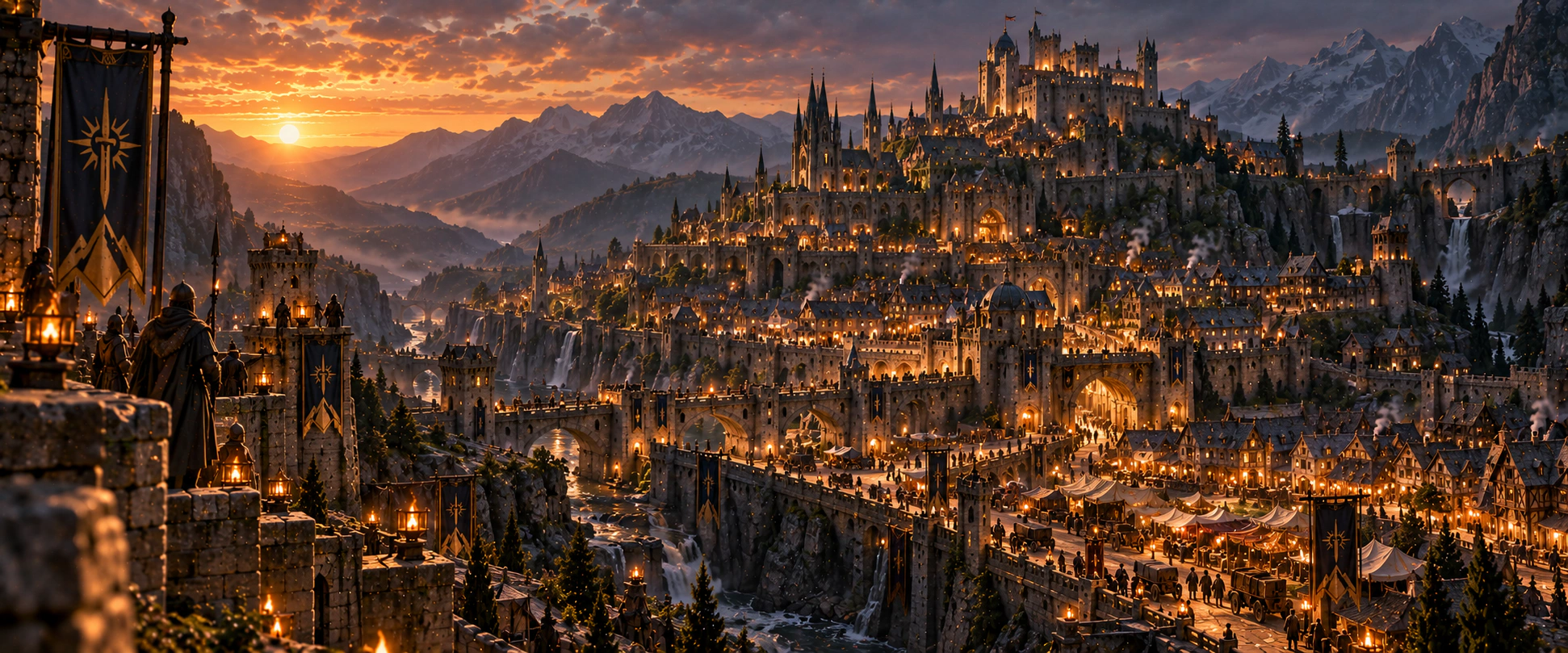
Highcourt is the capital of the fiefdom of the same name and the principal stronghold guarding the Great Pass through the Central Spine. Home to approximately 50,000 people, the city occupies the broadest and most defensible basin along the mountain corridor, with successive tiers of walls, towers and fortified terraces rising towards its ducal citadel.
Known throughout the Crownlands as the Everwatch, Highcourt is renowned for its formidable defences, disciplined military and unusual commitment to public security. Every street, stairway and public thoroughfare within its walls remains illuminated throughout the night, a longstanding civic tradition that has made the city one of the safest in the Crownlands.
Highcourt is ruled by Duchess Isolde Kestrel, Warden of the Great Pass, an experienced former commander of the Marchwardens. Its military strength is second only to Avarre amongst the Crownlander fiefdoms, although its forces specialise in defensive warfare, mountain operations and the protection of the Great Pass.
Geography
Highcourt stands within the Great Pass, the principal navigable route through the Central Spine. The Pass winds between steep mountains, alternating between broad valleys and narrower stretches enclosed by cliffs and rocky slopes.
The city occupies the largest natural basin along the route, where the surrounding mountains provide space for a substantial settlement while narrowing sufficiently at either end to allow its approaches to be heavily fortified.
Highcourt is built in successive tiers along the basin’s slopes, with the principal road passing through the lower city between its two great gates. Residential districts, workshops, markets and military installations occupy terraces protected by successive walls, while the ducal citadel commands the highest defensible position.
Mountain springs and streams provide a dependable water supply, although the city relies upon the surrounding settlements and valleys for much of its food and other necessities.
The Great Pass remains navigable beyond Highcourt, with broad stretches accommodating caravans and travellers. Smaller mountain trails offer alternative routes through the Central Spine, but these are difficult and unsuitable for large armies or substantial commercial convoys.
Government
Highcourt is a hereditary duchy ruled by Duchess Isolde Kestrel, who also holds the traditional title of Warden of the Great Pass. The title reflects the ruling family’s longstanding responsibility for maintaining the city’s fortifications and protecting the mountain territories under its authority.
Isolde, a human in her early fifties, served for more than two decades in the Marchwardens before inheriting the duchy. Disciplined, pragmatic and quietly compassionate, she is respected for her military experience, practical judgement and personal commitment to the welfare of her soldiers and subjects.
The Duchess governs with the assistance of the Council of Banners, an advisory body comprising senior military commanders, noble representatives and principal civic officials. Although influential in matters of defence, infrastructure and administration, the Council remains subordinate to the ducal authority.
Highcourt maintains close diplomatic relations with the other Crownlander fiefdoms, particularly Avarre. Duchess Isolde and Duchess Fionn Namatjira maintain an extensive personal correspondence, exchanging military advice, political observations and occasional private reflections despite the considerable distance between their territories.
Although Isolde supports Avarre’s struggle against the Eastern Reach, she remains reluctant to commit substantial numbers of Marchwardens to distant campaigns, believing that the defence of the Great Pass must remain Highcourt’s foremost responsibility.
Culture and Religion
Highcourt’s inhabitants are renowned for their discipline, civic responsibility and deeply ingrained culture of vigilance. Generations of military service and life within the Central Spine have fostered a society in which preparedness is regarded as a collective obligation.
The city’s traditional saying, “The watch is never finished,” reflects a belief that security depends upon the continued efforts of soldiers, officials, craftsmen and ordinary citizens alike.
Military service is widely respected, although not compulsory for all inhabitants. Families take pride in relatives who have served in the Marchwardens, while public ceremonies and commemorations frequently honour those who have defended the Great Pass.
Highcourt is also distinguished by its extensive system of permanent public illumination. Thousands of lanterns, braziers and sheltered lamps light its streets, stairways and squares throughout the night. A dedicated civic service known as the Lamplighters maintains this network, working closely with the Marchwardens to ensure that important routes and public spaces remain illuminated.
Combined with regular patrols and a strong culture of civic responsibility, this system has made violent crime, burglary and street theft relatively uncommon within the city’s walls. Fraud, private disputes and occasional corruption still occur, but Highcourt enjoys a reputation for exceptional public safety.
Despite its military character, Highcourt is accustomed to merchants and travellers passing through the Great Pass. Visitors are generally welcomed, although inspections, regulations and security procedures are enforced rigorously.
Worship of Valen, patron of warfare and honour, and Edrienne, associated with order and knowledge, is particularly prominent. Shrines and temples dedicated to the other recognised gods are also maintained throughout the city.
Military
Highcourt maintains the second most formidable military establishment amongst the Crownlander fiefdoms, surpassed only by Avarre.
Its principal standing force, the Marchwardens, is a professional military organisation specialising in mountain warfare, fortification defence, reconnaissance, patrols and the maintenance of secure supply routes.
Marchwarden garrisons occupy the city’s gates, towers and military districts, while smaller detachments maintain watchposts and patrol routes throughout the Great Pass.
The surrounding settlements also maintain local militias, which receive regular training and support the Marchwardens during emergencies.
Highcourt’s military doctrine places particular emphasis upon defensive depth, disciplined withdrawal, reliable communications and the maintenance of emergency supplies. Its successive walls and fortified terraces allow defenders to retreat into increasingly secure positions should an outer defence be breached.
Although smaller than Avarre’s armies and less experienced in large-scale offensive campaigns, the Marchwardens are exceptionally capable within the mountainous terrain of their homeland.
Trade and Economy
Highcourt’s economy is supported by trade through the Great Pass, mountain resources, agriculture and the considerable demands of its military establishment.
Merchants travelling through the Central Spine require accommodation, supplies, transport services and guides, while the duchy collects duties and maintains the principal roads.
Quarrying, forestry, metalworking and limited mining provide materials for construction, fortification and commerce. The surrounding valleys support agriculture and livestock, supplying much of the city’s food.
Military expenditure is a significant component of the local economy, sustaining armouries, workshops, construction projects, supply depots and numerous associated trades.
Although less commercially wealthy than Merrowyn, Highcourt enjoys relative prosperity through its strategic position, dependable infrastructure and the security afforded by its fortifications.
History
The Imperial Frontier
Highcourt was established during the expansion of the Lesterian Empire under King Aldrich Lester, when imperial armies advanced into the foothills of the Central Spine and annexed a collection of mountain settlements, valleys and fortified holdings.
The newly acquired territories were strategically valuable but difficult to defend, owing to their distance from the imperial heartlands and the challenging terrain of the Great Pass.
A permanent fortress was therefore constructed at the broadest and most defensible section of the mountain corridor, securing the Empire’s frontier, protecting its annexed settlements and maintaining its supply routes. Highcourt marked the furthest extent of sustained Lesterian expansion into the mountains.
Over subsequent generations, soldiers’ families, merchants, craftsmen and administrators settled around the fortress. As the settlement expanded, successive imperial governors constructed additional walls, towers and defensive works, gradually transforming the original stronghold into a fortified town.
The Long Dissolution
As the Lesterian Empire weakened, Highcourt’s distant garrisons became increasingly isolated from Cairnborn. Reinforcements, supplies and financial support grew unreliable, forcing the local military administration to assume greater responsibility for the surrounding settlements.
Highcourt’s independence emerged gradually through necessity rather than open rebellion. Its commanders continued defending the Great Pass even as the imperial institutions above them disappeared.
During this period, the military household that would become House Kestrel established its authority over the territory, eventually founding the hereditary duchy of Highcourt.
The tradition that Highcourt’s rulers should possess genuine military experience remains closely associated with these origins.
The Siege of the Ironward
During the instability of the early Fifth Era, a coalition of mountain lords attempted to seize Highcourt and establish control over the Great Pass.
The attackers captured several outlying watchposts and succeeded in breaching an older section of the western defences. Highcourt’s defenders withdrew into the inner fortifications and eventually forced the besieging forces to abandon their assault.
The siege demonstrated Highcourt’s ability to defend itself without imperial support, while exposing weaknesses in its existing fortifications.
Extensive reconstruction followed, contributing to the development of the modern Ironward Gate and the expansion of the city’s western defensive terraces.
The Long Winter
During an exceptionally severe winter in the middle Fifth Era, large numbers of hostile creatures descended from the Central Spine, including giants, trolls, ogres and other dangerous mountain inhabitants.
The creatures, driven towards the settled valleys by desperate conditions deeper in the mountains, attacked outlying settlements and isolated Highcourt from its surrounding territories.
Several watchtowers were destroyed, roads became impassable and the city endured weeks of siege and severe hardship.
Although the Marchwardens successfully defended Highcourt, the siege inflicted heavy losses and demonstrated the importance of maintaining reliable emergency supplies.
The Long Winter remains one of the most frequently commemorated events in the city’s history and a defining influence upon its traditions of preparedness.
The Night of Broken Lanterns
During a later Fifth Era assault, hostile creatures emerging from the surrounding mountains exploited poorly illuminated approaches and disabled several watchfires, allowing them to penetrate part of the lower city.
The Marchwardens eventually contained the incursion, but the attack caused considerable destruction and exposed weaknesses in Highcourt’s nighttime security.
In response, the ruling duke or duchess ordered a substantial expansion of the city’s public lighting network, accelerating the development of the system maintained today by the Lamplighters.
The Night of Broken Lanterns is widely regarded as a turning point in Highcourt’s transformation into the Everwatch.
The Everwatch
Across the centuries, successive rulers continued expanding and improving Highcourt’s fortifications, infrastructure and civic institutions.
Major additions to the city’s defensive works are traditionally commemorated by foundation stones recording the reigning ruler, the responsible master builder and the year of construction. These inscriptions can be found throughout Highcourt, including upon older walls now incorporated into residential streets and public buildings.
Today, Highcourt stands as one of the most formidable strongholds in the Crownlands, its layered defences and illuminated streets reflecting generations of military experience, civic investment and determination.
Districts
Gateward
The lower commercial district surrounding Dawnward Gate and the eastern approach to the city. Gateward contains markets, inns, caravan yards, merchants’ offices and warehouses, making it the busiest and most cosmopolitan quarter of Highcourt.
Stonehearth
The principal residential and commercial terraces, home to much of Highcourt’s civilian population. Houses, workshops, public squares and neighbourhood markets occupy its carefully maintained streets, while numerous lanterns illuminate the stairways and passages connecting its different elevations.
The Bastions
The city’s principal military district, extending towards Ironward Gate and the western fortifications. The Bastions contain Marchwarden barracks, training grounds, armouries, supply depots and defensive works, alongside housing and facilities serving military personnel and their families.
Crownwatch
The uppermost district of Highcourt, encompassing the ducal citadel, administrative buildings, noble residences and the chambers of the Council of Banners. Its elevated position commands views across the city and the approaches to the Great Pass.
Points of Interest
Dawnward Gate
The great eastern entrance to Highcourt, facing the wider Crownlands. Its monumental gatehouse, inspection courts and adjoining barracks accommodate the substantial flow of merchants, travellers and military convoys entering the city.
Dawnward developed as Highcourt expanded beyond its original imperial fortifications and remains the city’s principal civic gateway.
Ironward Gate
The heavily fortified western entrance to Highcourt, facing deeper into the Central Spine. Its oldest foundations date to the city’s origins as an imperial frontier fortress, although the present structure has been rebuilt and expanded repeatedly.
Ironward incorporates reinforced gates, multiple portcullises, defensive galleries and extensive adjoining fortifications. A substantial Marchwarden garrison is permanently stationed nearby.
Kestrel Keep
The ducal citadel and residence of Duchess Isolde Kestrel, occupying the highest defensible position within Highcourt. Its towers overlook the city and both approaches to the Great Pass, while its chambers accommodate the ducal household and the Council of Banners.
The oldest sections of the keep incorporate surviving elements of the original imperial fortress.
The Hall of the Watch
The administrative and ceremonial headquarters of the Marchwardens, containing military archives, offices, assembly chambers and memorials honouring those who have died defending Highcourt.
The Hall preserves records of the city’s major sieges and the names of commanders, soldiers and citizens distinguished in its defence.
The Thousand Lights
Highcourt’s principal public square, renowned for its elaborate arrangement of permanent lanterns and braziers. The square remains brightly illuminated throughout the night and serves as a gathering place for civic ceremonies, military commemorations and public celebrations.